Short answer
Most people searching for a Brevo alternative are really asking two questions at once. One is about campaigns: newsletters, automations, landing pages. The other is about the mail your app sends on its own, like password resets, sign-in codes and receipts. Those are different jobs, and they should not share sending IPs. A promotion that annoys a mailbox provider should never be able to slow down a sign-in code. This page compares Brevo with Mailchimp, HubSpot and GetResponse for the campaign side. It then covers a sender built for transactional email, for teams whose Brevo account mostly sends mail a user is waiting on.
Who this comparison is for, and who it is not
This page is for two kinds of readers.
- Teams that use Brevo for marketing and want a different campaign platform. The Mailchimp, HubSpot and GetResponse sections are for you.
- Developers and product teams that use Brevo mainly for transactional mail, sent through its API or SMTP relay. These are the resets, one-time codes, receipts and alerts your app triggers. The Groundmail section is for you.
If you send both kinds of mail, you may not need to replace Brevo at all. You may only need to move one of the two jobs off it.
This page is not for teams looking for cold outreach tooling. None of the options below is pitched at that.
Why transactional mail belongs apart from marketing mail
Brevo's own transactional email page defines the category well. Transactional emails are one-to-one messages triggered by a user's action. They carry account or purchase information, and the recipient expects them. Bulk marketing email is the opposite: one message to a list, often unprompted.
The two behave differently once they reach a mailbox provider. Marketing sends draw complaints, unsubscribes and spam-folder votes, because some recipients did not want them. Transactional sends rarely do, because the recipient asked for the email a few seconds ago. Reputation attaches to the IPs and domains the mail leaves from. When both kinds of mail share that path, the campaign's reputation becomes the password reset's reputation.
So the useful question to ask any platform is not "does it do transactional email?" All four marketing platforms below mention it somewhere. The useful question is "which IPs do my resets leave from, and what else is sent from them?"
How we compared these tools
These are the criteria that matter when you are leaving Brevo:
- What the platform is built for. Campaigns, CRM, or app-triggered mail.
- The free option. Whether one exists and what it caps.
- Paid plans and prices. Taken only from each tool's own pricing page.
- Where transactional sending and dedicated IPs sit. Whether isolation is available on every plan or only at the top of the ladder.
- Who runs the sending infrastructure. This is the party that can read the logs and change the IPs when a reset lands in spam.
Brevo's own roundup of email marketing platforms makes a related point in its criteria. It says the best platforms have their own SMTP servers, because deliverability decides whether email reaches the inbox at all. That standard applies even more strongly to a sign-in code.
Brevo alternatives at a glance
| Tool | Built for | Free option | Paid plans and prices |
|---|---|---|---|
| Brevochecked | Email, SMS, CRM and marketing automation on one platform | Free forever plan, no credit card needed | Starter from 5,000 emails/month. Standard adds automation and A/B testing. Professional from 150,000 emails/month. Enterprise is through sales. Yearly billing saves 10%. |
| Mailchimpchecked | Email and SMS marketing | Free under 250 contacts. Capped at 500 emails/month or 250/day, with 1 seat. | Standard starts at $20/month after a 14-day free trial, with up to 6,000 emails/month. Essentials sits below Standard. Premium is $350/month for 12 months on the 15%-off offer for 10,000+ contacts, with up to 150,000 emails/month. |
| HubSpotchecked | Marketing, sales and service software on one platform | Free and premium Marketing Hub plans | Small Business Bundle with the Starter edition of each product |
| GetResponsechecked | Email marketing, automation, landing pages and course selling | Free account, plus a 14-day trial of premium features | Starter $19/mo ($15.58/mo paid annually). Marketer $59/mo ($48.38/mo paid annually). Creator $69/mo ($56.58/mo paid annually). Enterprise has custom pricing. Unlimited monthly email sends on every plan. |
| Groundmail | Transactional, product and opt-in newsletter email (newsletters by approval), each on its own IPs, through an API and SMTP relay. No cold email. | Free $0/month: 3,000 emails/month, 100/day, 3 domains | Pay as you go, no plans to pick: $15 a month with 20,000 emails included, then $0.70 per 1,000 up to 100,000, $0.50 from 100,000 to 1 million and $0.30 above 1 million. Dedicated server from $299/month with 250,000 emails, then $0.40 per 1,000. |
Last checked on each vendor's public page.
What a month of sending costs per 1,000 emails
Marketing platforms price by contacts. Transactional senders price by emails. The table below divides each plan's published monthly price by the emails it includes. That gives a rough cost per 1,000 at the plan's cap, using only figures from each tool's own pricing page.
| Plan | Monthly price | Emails included | Cost per 1,000 at the cap |
|---|---|---|---|
| Mailchimp Standard (starting tier)checked | $20 | up to 6,000 | $3.33 |
| Mailchimp Premium (12-month offer price)checked | $350 | up to 150,000 | $2.33 |
| Groundmail pay as you go, 50,000 emails | $36 | 50,000 | $0.72 average |
| Groundmail pay as you go, 100,000 emails | $71 | 100,000 | $0.71 average, then $0.50 per 1,000 |
| Groundmail dedicated server | $299 | 250,000 | $1.20, then $0.40 per 1,000 |
Last checked on each vendor's public page.
Read this as a sense of scale, not a like-for-like quote. Mailchimp's price also rises with contact count. GetResponse includes unlimited monthly sends, so a per-email figure does not apply to it. Brevo's pricing page lists email volumes per plan, but the dollar amounts did not come through in the version we read, so Brevo is not in this table.
Brevo
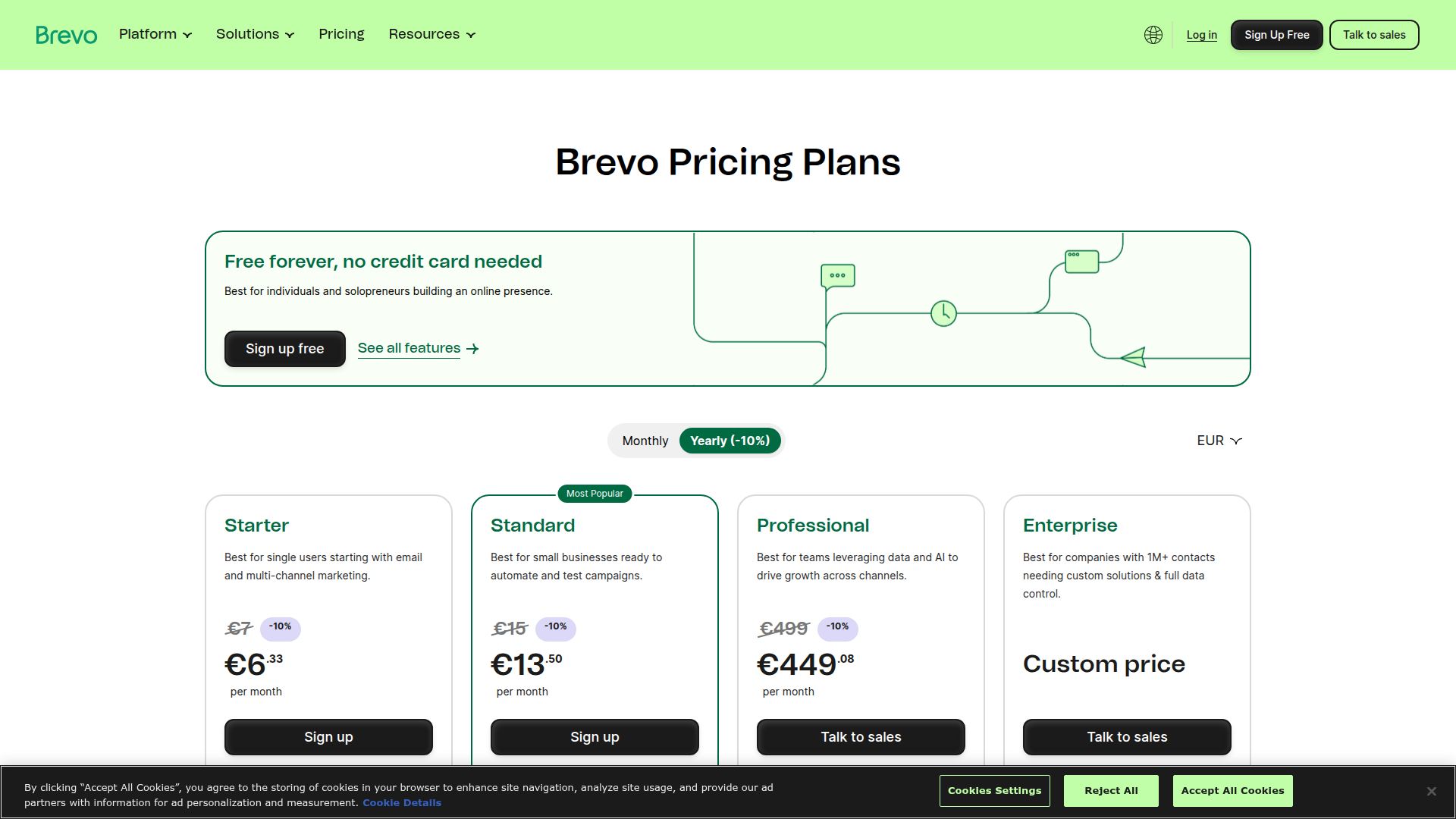
Brevo's pricing page, as of October 24, 2026.
Brevo sells itself as one customer platform covering email, SMS, WhatsApp, CRM and loyalty. Transactional sending is part of that platform. The FAQ on Brevo's pricing page says every plan includes transactional email features: RESTful APIs, SMTP and outbound webhooks.
The plan ladder runs as follows:
- Free: free forever, with no credit card needed.
- Starter: from 5,000 emails a month.
- Standard: adds marketing automation, A/B testing and advanced reporting.
- Professional: from 150,000 emails a month. It adds 10 seats, phone support and 3 hours a year with a deliverability specialist.
- Enterprise: described as best for companies with 1M+ contacts. This is the plan where the pricing page lists a dedicated IP, along with SSO and SAML.
Yearly billing takes 10% off.
Brevo's transactional email page says more about the sending side. It claims a 99% delivery rate and 99.9% uptime. It also lists inbound parsing, real-time webhooks and SDKs. It says optional dedicated IPs with automated warming are available for high-volume senders.
Who it suits: teams that want campaigns, CRM and app mail in one account and are comfortable with that tradeoff. If your resets and your newsletters both go through Brevo, ask which IPs each one leaves from before you decide to stay.
Mailchimp
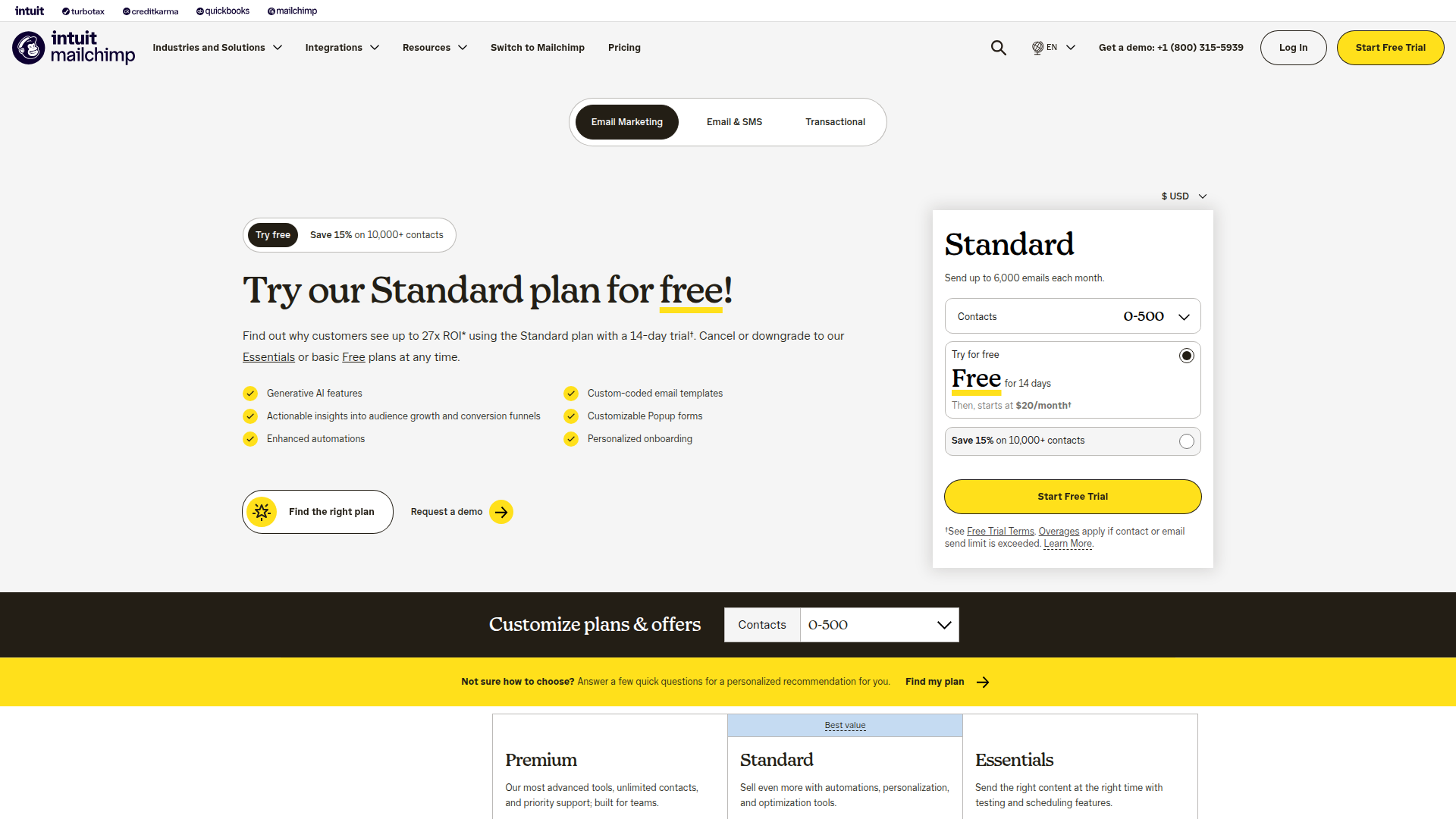
Mailchimp's pricing page, as of October 24, 2026.
Mailchimp is a marketing platform first. Its pricing page is split into Email Marketing, Email & SMS, and Transactional tabs. Its developer menu lists a Marketing API and a separate Transactional API.
On the marketing side, the plans are:
- Free: for under 250 contacts, capped at 500 emails a month or 250 a day, with one seat.
- Essentials: sits below Standard.
- Standard: starts at $20 a month after a 14-day free trial, with up to 6,000 emails a month.
- Premium: $350 a month for the first 12 months on Mailchimp's 15%-off offer for 10,000+ contacts. It allows up to 150,000 emails a month and adds phone and priority support.
One line on Mailchimp's pricing page matters if you are tempted to run app mail through a free marketing plan. Near the free plan, it says sending will be paused if the contact or email send limit is exceeded. A paused newsletter is an inconvenience. A paused password reset locks a user out.
Who it suits: teams moving campaigns off Brevo that want a familiar editor, templates and 300+ integrations.
HubSpot
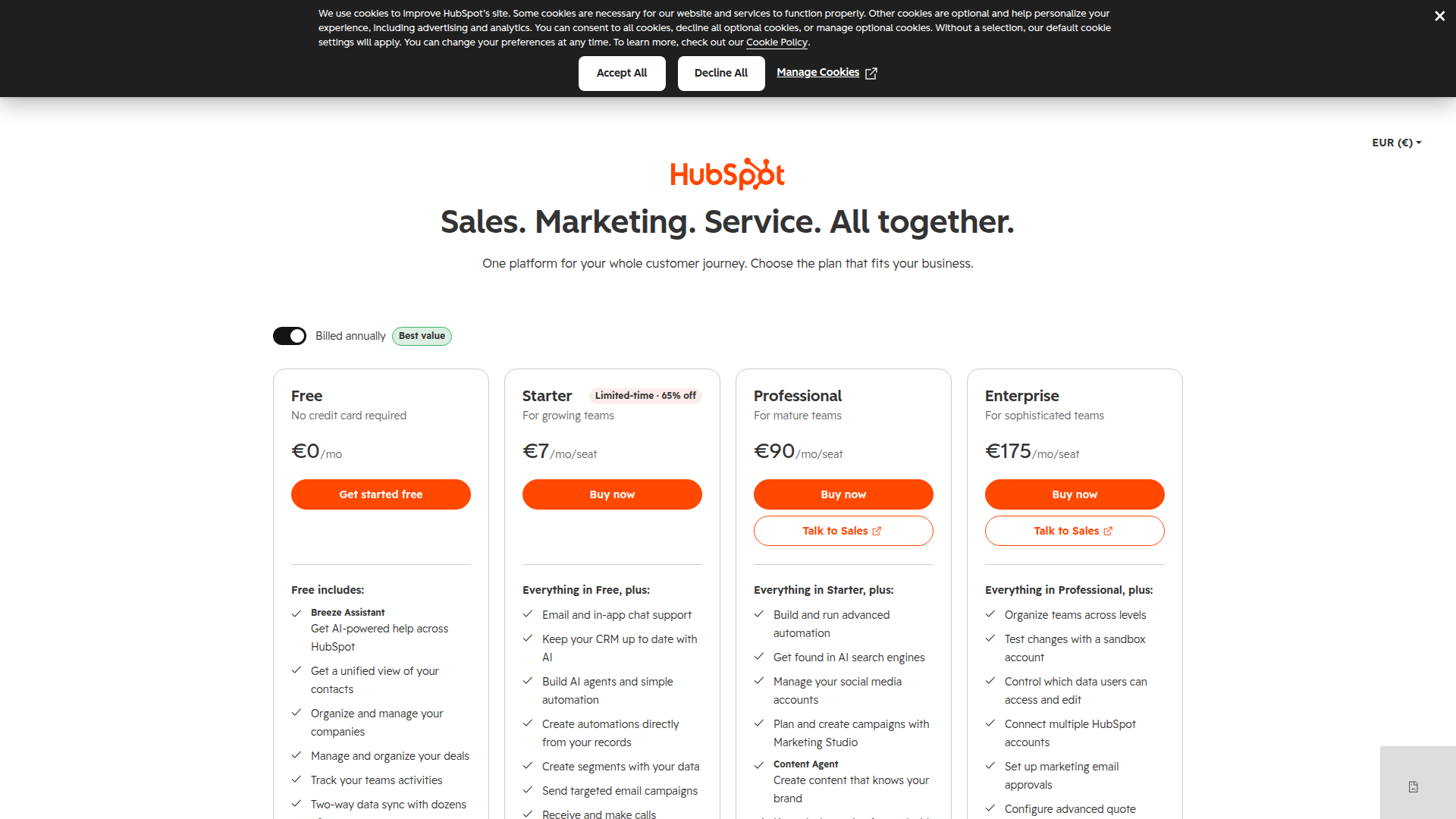
HubSpot's pricing page, as of October 24, 2026.
HubSpot's homepage pitches one platform for marketing, sales and customer service, with a free CRM at the center. Marketing Hub, its marketing automation product, comes in free and premium plans. A Small Business Bundle packages the Starter edition of each product for startups and small businesses.
The pitch is about building demand, winning deals and keeping customers. If you chose Brevo partly for its CRM and sales pipelines, HubSpot is the closest like-for-like move.
Who it suits: teams whose Brevo use is really CRM plus campaigns, and who want marketing tied to a sales pipeline.
GetResponse
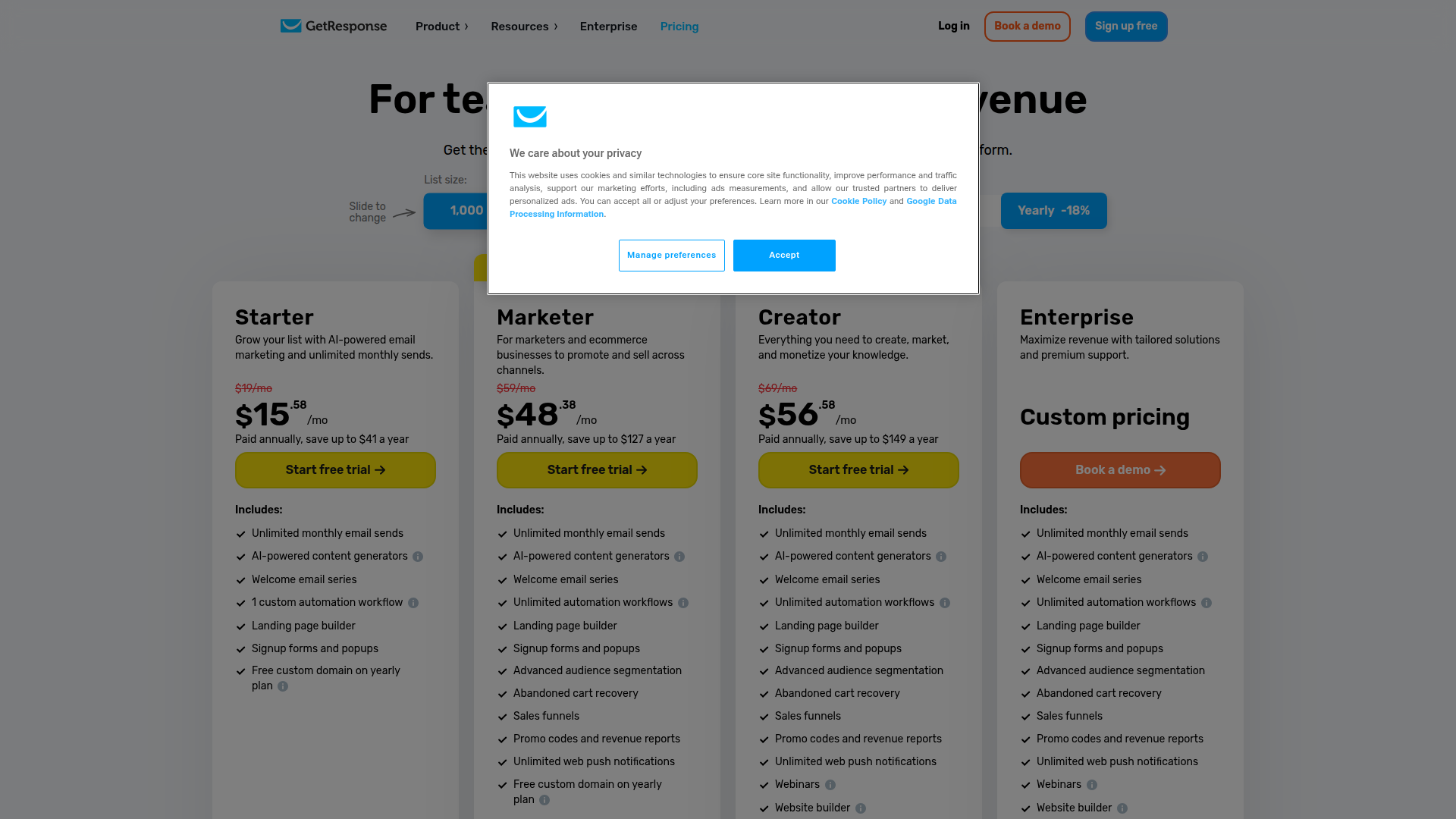
GetResponse's pricing page, as of October 24, 2026.
GetResponse bundles email marketing with landing pages, webinars, a course creator and paid newsletters. Every plan on its pricing page includes unlimited monthly email sends:
- Starter: $19/mo, or $15.58/mo paid annually. Includes one custom automation workflow.
- Marketer: $59/mo, or $48.38/mo paid annually. Adds unlimited workflows, abandoned cart recovery and sales funnels.
- Creator: $69/mo, or $56.58/mo paid annually. Adds webinars, a website builder and courses for up to 500 students.
- Enterprise: custom pricing. This is the plan where the pricing page lists transactional emails, a dedicated sending domain, a dedicated IP address and SSO.
A free account is available, and the 14-day trial unlocks premium features. The FAQ notes that the free account adds a GetResponse badge to every message, which you can only remove by upgrading. Charities and NGOs get 50% off monthly plans.
Who it suits: creators and marketers who want email, landing pages and webinars from one vendor. As with Brevo, transactional email and dedicated IPs sit at the top tier.
Groundmail
Groundmail is the option for the other job. It's built for the mail your app sends, through an HTTP API (POST /emails), an SMTP relay, SDKs for Node, Python, Go, PHP and Ruby, a CLI and an MCP server. If your Brevo account exists mainly to deliver resets, codes, receipts and alerts, this is where that mail can move.
What shares your IPs
Our shared transactional IPs carry password resets, sign-in codes, receipts and alerts, and nothing else. Product email and opt-in newsletters send from their own IPs, with their own bounce and complaint tracking, and cold email and purchased or scraped lists aren't allowed at all. Reputation on a shared pool is pooled, so the rules about who can send are what keep it clean. Our page on how we protect your reputation covers that in more detail.
Who runs the mail servers
Groundmail sends from mail servers and IP space we own and operate. When a reset lands in spam, the team that can read the logs and change the IPs is the team you are already talking to. That also helps with security and procurement reviews. Your reviewers get one accountable party for the infrastructure behind sign-in and receipt mail.
Dedicated IPs or a dedicated server on the same API
On Brevo and GetResponse, a dedicated IP appears on the Enterprise plan. With Groundmail, dedicated IPs and dedicated servers sit behind the same API as the shared pool. You can start on Free or pay as you go and move to isolated sending when volume, a security review or procurement calls for it. Your integration does not change when you move.
Sending the first email
Your code makes one call to POST /emails from any of the SDKs or the CLI. If your app already speaks SMTP, which is likely if it talks to Brevo's relay today, point it at smtp.groundmail.dev. Our SMTP relay page has the settings.
Moving transactional mail over
- Add your sending domain and publish the SPF, DKIM and DMARC records Groundmail gives you.
- Run your app against test mode first, so nothing reaches real inboxes.
- Switch one message type, such as sign-in codes, and watch the webhooks for bounces and deliveries.
- Move the rest. Keep Brevo for campaigns if you still use them.
Our guide on switching transactional email providers without downtime walks through running both providers during the cutover.
What you give up
Groundmail sends opt-in newsletters only for accounts we approve, and marketing campaigns are coming later. There is no list builder, campaign editor or landing pages today, and cold outreach is never allowed. If you need campaigns now, keep a marketing platform for them.
Pricing at your volume
Groundmail's pricing:
- Free: 3,000 emails a month, 100 a day and up to 3 domains, at no cost.
- Pay as you go: no plans to pick. $15 a month with 20,000 emails included, then $0.70 per 1,000 up to 100,000, $0.50 from 100,000 to 1 million and $0.30 above 1 million. 50,000 emails is $36 and 100,000 is $71. A dedicated IP is included from 100,000 emails a month.
- Included at every volume: inbound, templates, automations, webhooks, SMTP and up to 1,000 sending domains.
- Dedicated server: from $299 a month, with 250,000 emails included and $0.40 per 1,000 after.
The pricing page has the full tier list.
The pick
Choose by the job, not by the vendor count.
- Moving campaigns off Brevo: Pick Mailchimp for a familiar editor and integrations. Pick HubSpot if marketing should live next to a CRM and sales pipeline. Pick GetResponse if you also sell courses or run webinars.
- Your Brevo account mostly sends resets, sign-in codes and receipts: do not move that mail to another all-in-one marketing platform. Move it to a sender built for transactional mail, where the shared transactional IPs carry nothing else.
- You do both: split them. Campaigns go on a marketing platform. App mail goes on a transactional service.
Start sending free
If your Brevo account is really a password-reset and receipt pipeline, move that mail somewhere built for it alone. Groundmail's free plan covers 3,000 emails a month, sent from IPs that carry only transactional mail. You can create your free account and send your first email today.
Frequently asked questions
Is a Sendinblue alternative the same thing?
Yes. Brevo is the company formerly called Sendinblue, so the same options apply.
Does Brevo's free plan include transactional email?
Brevo's pricing page FAQ says all of its plans give access to transactional email features, including RESTful APIs, SMTP and outbound webhooks.
Can I keep Brevo for newsletters and move only transactional mail?
Yes, and for many teams that is the right move. Send campaigns from Brevo's marketing tools and send app-triggered mail from a separate transactional service on its own domain or subdomain.
Do I need a dedicated IP for password resets?
Usually not at first. A clean shared pool is fine for most teams. Dedicated IPs make sense once your volume is steady enough to build its own reputation, or when a review requires isolation. Our guide to shared vs dedicated IPs for transactional email covers when to switch.
Can I send newsletters through Groundmail?
Yes, opt-in newsletters, once we approve your account (email support@groundmail.dev). They go out from their own IPs with one-click unsubscribe, separate from your transactional and product email, so a newsletter can't hurt your sign-in codes. Marketing campaigns are coming later. Cold email and purchased or scraped lists are never allowed.
Will my app need a rewrite to switch?
No, if your app already uses SMTP. Change the host and credentials. If you call Brevo's API, swap that call for POST /emails using one of the SDKs.