Short answer
A shared IP pool is only as good as what its operator refuses to send through it. Resend and SendGrid both sell transactional and marketing email. When you compare them for password resets and receipts, the deciding question is who else shares the IPs your sign-in codes leave from. Price and API design matter too. This page covers four questions: what each tool costs, how you send with it, how isolation works, and when a provider that keeps transactional mail on IPs of its own is the better fit.
This page is for developers and product teams choosing a sender for mail a user is waiting on: resets, magic links, receipts and alerts. If you also need newsletters from the same vendor, the trade-offs below still apply, but you will weigh them differently.
What to compare
PkgPulse's guide to these providers frames the job well: transactional email needs reliable delivery, not a mailing list platform. These criteria follow from that:
- Free tier shape. Daily caps, monthly caps and domain limits decide whether you can launch without paying.
- How you send. The REST API, the SMTP relay and the SDKs for your language.
- Who shares your IPs. On a shared pool, reputation is pooled. Marketing and cold mail on the same IPs can drag down your reset emails.
- Isolation. What a dedicated IP costs and the volume at which a provider will give you one.
- Everything around sending. Inbound mail, webhooks, templates and log retention.
Resend vs SendGrid vs Groundmail at a glance
| Topic | Resendchecked | SendGridchecked | Groundmail |
|---|---|---|---|
| Free entry | Free-forever plan, 100 emails a day, 3 custom domains | Free trial, no credit card required | Free plan, 3,000 emails a month, 100 a day, 3 domains |
| What it sends | Transactional and marketing ("Deliver transactional and marketing emails at scale") | Email API and SMTP service, plus Marketing Campaigns | Transactional, product and opt-in newsletter email (newsletters by approval), each on its own IPs. No cold email. |
| How you send | REST API, SMTP relay, SDKs for Node.js, Ruby, Python, PHP, Go, Rust, Java, Elixir and .NET, plus a CLI | Email API and SMTP service | HTTP API (POST /emails), SMTP relay, SDKs for Node, Python, Go, PHP and Ruby, a CLI and an MCP server |
| Dedicated sending | Dedicated IP add-on at $30/mo on Scale, for senders above 3,000 emails a day | Part of Twilio's platform | Dedicated IP included from 100,000 emails a month (extra IPs $25/mo), or a dedicated server from $264/mo, on the same API |
| Infrastructure | Managed service | SendGrid's site is now part of Twilio.com | Sends from Groundmail's own mail servers and IP space |
Last checked on each vendor's public page.
Pricing and free tiers compared
| Provider | Free entry | Paid plans | Overage | Dedicated IP |
|---|---|---|---|---|
| Groundmail | Free $0/mo: 3,000 emails/month, 100/day, 3 domains | Pay as you go, no plans to pick: $15 a month with 20,000 emails included, then $0.70 per 1,000 up to 100,000, $0.50 from 100,000 to 1 million and $0.30 above 1 million. Up to 1,000 domains | One rate per volume band, no plan overage | Included from 100,000 emails/month, extra IPs $25/mo. Dedicated server from $264/mo, 250,000 emails included, $0.40 per 1,000 after |
| Resendchecked | Free: 100/day, 3 custom domains, 1 webhook endpoint, 30 days data retention | Pro: no daily limit, 10 domains, 5 webhook endpoints. Scale: no daily limit, 1,000 domains, 10 webhook endpoints. Enterprise: flexible | Pay-as-you-go in buckets of 1,000 at the plan's overage rate, if enabled | $30/mo add-on on Scale and Enterprise, for senders above 3,000 emails/day |
| Mailgunchecked | Free $0/mo: 100 emails/day, 1 domain, 1 day log retention | Basic from $15/mo: 10,000 emails. Foundation $35/mo after a free first month: 50,000 emails, 1,000 domains. Scale $90/mo after a free first month: 100,000 emails | Basic from $1.80, Foundation from $1.30, Scale from $1.10 per 1,000 | One included with Foundation 100k, Growth and Scale. Extra IPs $59/IP/month |
| Postmarkchecked | Free: 100 emails/month, never expires, no overages | Basic $15.00, Pro $16.50, Platform $18.00, each at 10,000 emails/month | Basic $1.80, Pro $1.30, Platform $1.20 per 1,000 | From $50/month per IP, Pro or higher, for senders at 300,000+ emails/month |
| Unosendchecked | 3,000 free credits on signup | Starter $4 per 10,000 emails, no subscription, credits valid 90 days. Business: custom, for 500K+ | Buy more credits | $30/month, billed annually ($360/yr) |
Last checked on each vendor's public page.
Postmark's pricing page has a monthly/yearly toggle. The Postmark prices above are as the page showed them, at its 10,000-email setting. Resend's FAQ says it offers monthly plans only, with no annual discount, and 50% off paid plans for registered nonprofits. Resend sells 100 more domains as a $20/mo add-on on Pro and Scale. Single Sign-On is a $150/mo add-on on Scale only. It is not offered on Free or Pro, and it is included on Enterprise.
SendGrid's homepage says its site has merged into Twilio.com, where its plans now live. Its own site states a free trial with no credit card required.
The free tiers differ on domain limits, which matters if you run several side projects. Resend's free plan allows 3 custom domains, Groundmail's free plan allows 3, and Mailgun's free plan allows 1. Unosend's Starter credits come with unlimited domains.
What 50,000 and 100,000 emails a month cost
This table is arithmetic on the plan prices and overage rates above. It covers the providers whose plans make the sum direct. Mailgun's overage rates are "from" figures, so treat its overage totals as the starting point.
| Monthly volume | Groundmail | Mailgunchecked | Unosendchecked |
|---|---|---|---|
| 50,000 | $36 | $35 (Foundation, included, after the free first month) | $20 in credits (5 × $4), valid 90 days |
| 100,000 | $71 | $90 (Scale, included) or $100 on Foundation ($35 + 50,000 × $1.30 per 1,000) | $40 in credits (10 × $4) |
Last checked on each vendor's public page.
Groundmail's bill is $15 a month with 20,000 emails included, then $0.70 per 1,000 up to 100,000, $0.50 from 100,000 to 1 million and $0.30 above 1 million, so 50,000 emails is $36 and 100,000 is $71. Sent and received emails count the same. Our pricing page has the full rate table. For Resend and SendGrid, run your own volume through their pricing pages before you commit.
Sending a password reset through each API
Resend's homepage shows its Node.js call. A password reset uses the same call with your own sender and content:
import { Resend } from 'resend';

const resend = new Resend('re_xxxxxxxxx');

const { data, error } = await resend.emails.send({
  from: 'onboarding@resend.dev',
  to: 'delivered@resend.dev',
  subject: 'Hello World',
  html: '<strong>it works!</strong>'
});

if (error) {
  console.log(error);
}
Resend's pricing FAQ adds a limit worth knowing before launch day. The API rate limit is set per team and is the same on every plan, so upgrading does not raise it. Its Batch Email API sends up to 100 emails in one request, and each batch counts as one request.
SendGrid offers an Email API and an SMTP service under Twilio. Groundmail takes a single POST to /emails over HTTP, or the same message over SMTP relay.
SMTP relay and SDKs
All three accept SMTP. That matters when your mail is sent by a framework, a CMS or a third-party app you cannot rewrite. For code you do control, SDK coverage decides how much glue you write.
- Resend lists SDKs for Node.js, Ruby, Python, PHP, Go, Rust, Java, Elixir and .NET. It also offers a CLI, REST, SMTP and first-class React Email templates.
- SendGrid offers its Email API and SMTP service.
- Groundmail has official SDKs for Node, Python, Go, PHP and Ruby, a CLI, an MCP server for AI coding agents, and an SMTP relay.
Mailgun and Postmark both list a REST API, SMTP and official SDKs on their pricing pages. Unosend lists a REST API and SMTP relay on its Starter plan.
Who owns the mail servers and IP space
When a reset email lands in spam, someone has to read the logs, check the IP's standing and change what is sending. If your provider runs the servers and IPs, that work happens in one place. If it does not, your ticket travels further before anyone can act on it.
Groundmail sends from mail servers and IP space it owns and operates. This matters most in two situations. The first is debugging a deliverability problem. The second is answering a security or procurement review that asks who handles your sign-in mail. Unosend's homepage also says it runs "own infrastructure with warmed IPs." For any provider, ask the question directly and put the answer in your review.
Dedicated IPs and dedicated servers
A dedicated IP removes the pooled-reputation problem, but it has to be warmed up and fed steady volume. That is why providers set volume thresholds:
- Resend: $30/mo add-on on Scale for senders above 3,000 emails a day. Resend says it will warm up, monitor and autoscale the IP.
- Mailgun: one dedicated IP included with Foundation 100k, Growth and Scale. Extra IPs cost $59/IP/month. Scale adds dedicated IP pools.
- Postmark: from $50/month per IP on Pro or higher, for senders at 300,000+ emails a month.
- Unosend: $30/month billed annually, available on all plans, with warm-up guidance. Its pricing page calls it ideal for 300K+ emails a month.
- Groundmail: dedicated IPs or a dedicated server behind the same API as the shared pool. A dedicated IP is included from 100,000 emails a month on pay as you go (extra IPs $25/mo), and a dedicated server starts at $264/mo with 250,000 emails included.
Do not buy isolation on day one. Start on a clean shared pool, and move when your volume, a security review or a procurement checklist calls for it. When the same API serves both, the move should be a setting, not a rewrite.
Inbound, webhooks, templates and automations
- Resend includes inbound email on every plan, and each received email counts against your transactional quota. Every plan includes 3 inboxes, with extras at $1 per inbox on paid plans. You get 1 webhook endpoint on Free, 5 on Pro and 10 on Scale, all with every event type.
- Mailgun gives 1 inbound route on Free, 5 on Basic and full inbound routing from Foundation up. Templates and webhooks come on every plan.
- Postmark includes inbound email processing on Pro and Platform. It turns inbound mail into JSON and posts it to a webhook. It also has templates and event webhooks.
- Unosend includes webhooks and open and click tracking on Starter.
- Groundmail includes inbound email, webhooks, templates and automations.
Mailgun, Postmark and Unosend
Teams comparing Resend and SendGrid usually have these three open in other tabs.
Mailgun runs four plans from Free to Scale. It hosts in both the US and the EU, so your data can stay in your chosen region. Its pricing page says it sends over 600 billion emails a year. Log retention is short on the low tiers: 1 day on Free and Basic, 5 on Foundation and 30 on Scale.
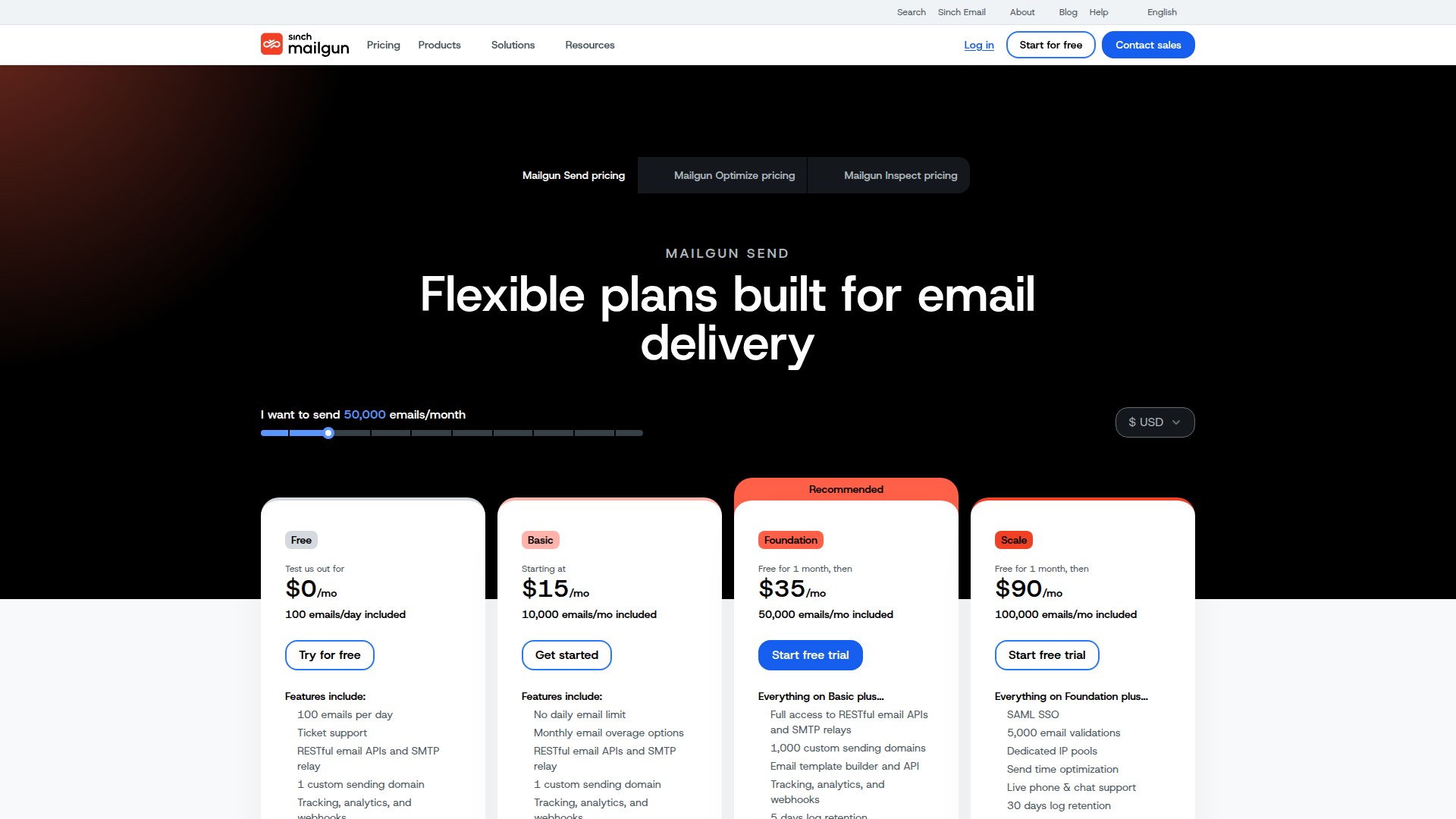
Mailgun's pricing page, as of October 24, 2026.
Postmark starts every account on a free developer plan of 100 emails a month that never expires. Paid plans include 45 days of full message retention by default, customizable from 7 to 365 days. Postmark claims delivery up to 4x faster than other providers. It separates transactional and bulk mail into message streams.
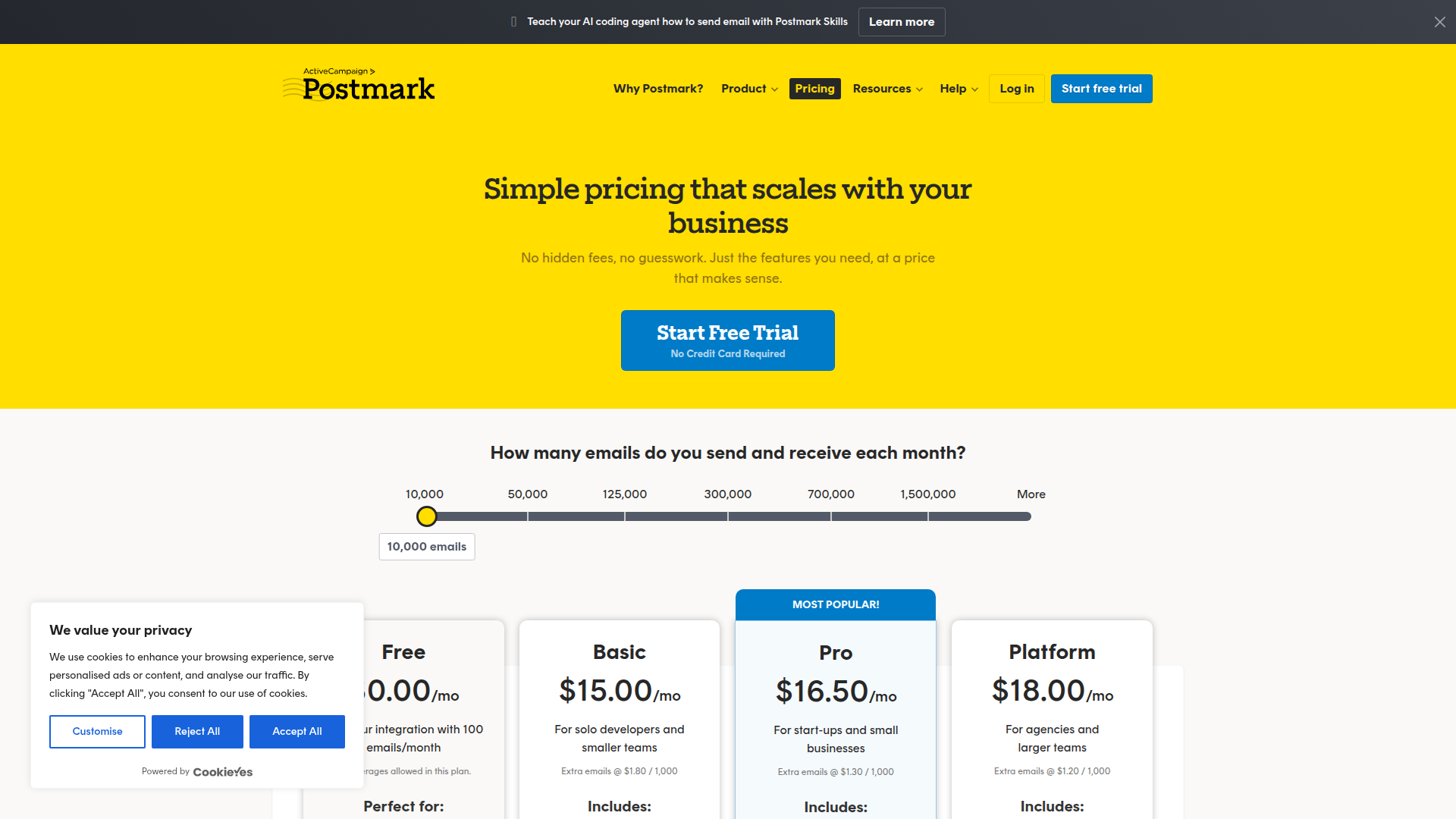
Postmark's pricing page, as of October 24, 2026.
Unosend prices by credits rather than a subscription: $4 per 10,000 emails, with credits valid 90 days and no minimum top-up. Its site says the company is being acquired and service continues as normal.
Resend
Resend's homepage calls it "Email for developers," built by "a team of engineers who love building tools for other engineers." Its strengths are the SDK list, React Email support and a free-forever plan with 3 custom domains. It sells marketing email through Broadcasts, which count against contacts rather than the transactional quota. Inbound mail does count against that quota.
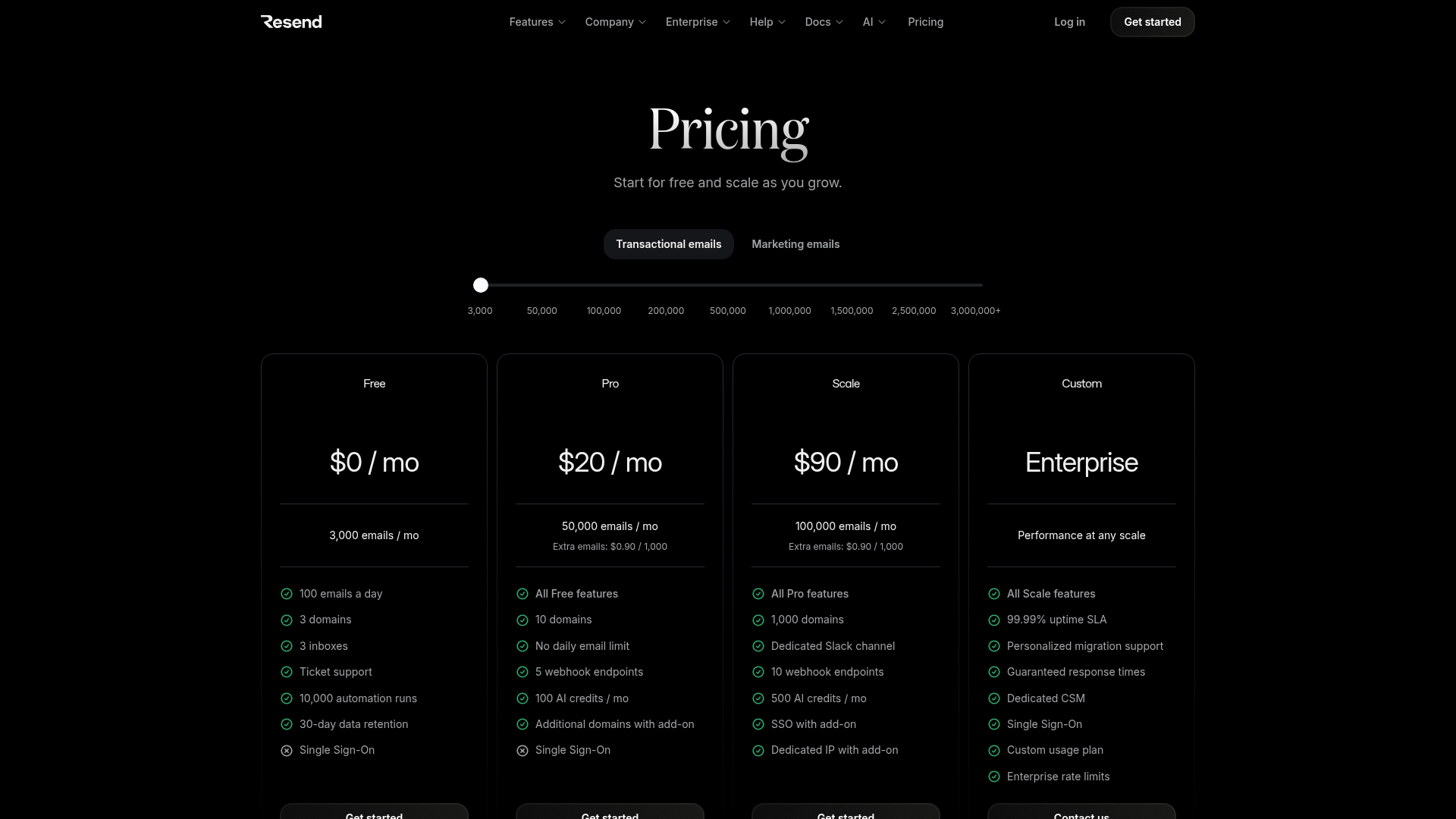
Resend's pricing page, as of October 24, 2026.
Pick Resend if you want React Email templates, a broad SDK list and one vendor for both product email and newsletters.
SendGrid
SendGrid is Twilio's email product, and its site has moved into Twilio.com alongside SMS, voice and verification. It offers an Email API, an SMTP service and Marketing Campaigns. Its homepage cites more than 200 billion emails delivered every month. It starts with a free trial that needs no credit card.
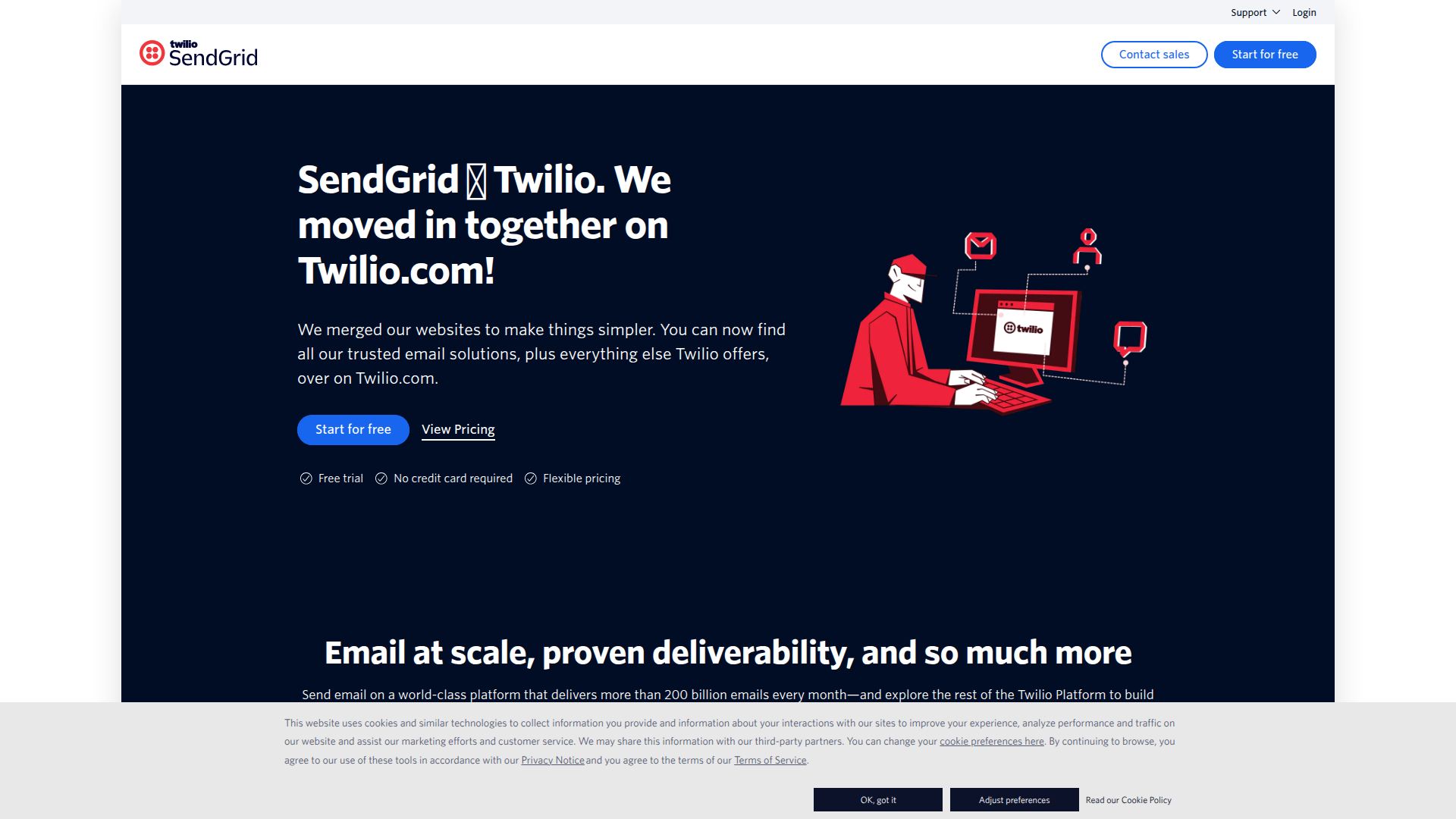
SendGrid's pricing page, as of October 24, 2026.
Pick SendGrid if you already run on Twilio, want email next to SMS and verification on one account, or need a marketing campaigns tool from the same vendor.
Groundmail
Groundmail is a transactional email API and SMTP relay that sends from its own mail servers and IP space. Transactional, product and opt-in newsletter email each send from their own IPs, so the shared transactional pool carries only resets, receipts, sign-in codes and alerts. Cold email is never allowed. Dedicated IPs and dedicated servers sit behind the same API. Pricing starts with Free at 3,000 emails a month, then pay as you go at $15 a month with 20,000 emails included and lower per-email rates as you grow, with a dedicated server from $264/mo.
Switching from SendGrid or Resend
The safe way to move is to run both providers in parallel. Verify your domain on the new sender and publish its SPF and DKIM records. Move one low-risk email type first, then the rest. Our walkthrough on switching providers without downtime covers the order of steps. The SendGrid migration guide maps SendGrid calls to Groundmail's. If your app sends over SMTP, switching means entering new host details and credentials.
When Groundmail is the wrong choice
Groundmail doesn't have marketing campaigns yet (they're coming later), sends opt-in newsletters only for accounts we approve, and never sends cold outreach. If you want a campaign editor and contact lists next to your password resets today, Resend or SendGrid will serve you better. If you want the widest SDK list, Resend lists nine languages where Groundmail has official SDKs for five.
Which one to pick
- Resend if you want React Email, a wide SDK list, and transactional plus marketing mail from one vendor.
- SendGrid if you are already on Twilio and want email alongside its other channels.
- Groundmail if you want your sign-in codes on a shared pool that carries only transactional mail, with product email and newsletters on their own IPs, and you want to know who runs the servers when a reset lands in spam.
For transactional mail, ask every provider what else runs on its shared IPs. That answer predicts your inbox placement better than any feature grid.
Send your first email free with Groundmail
If your mail is resets, receipts, sign-in codes and alerts, Groundmail's Free plan covers 3,000 emails a month on IPs that carry only transactional mail. Create your free account and send your first email.
Frequently asked questions
Does Resend have a free plan?
Yes. Resend offers a free-forever plan with 100 emails a day and 3 custom domains. Its FAQ says there is no free trial of paid plans.
Does SendGrid have a free option?
SendGrid's site offers a free trial with no credit card required.
Is Resend or SendGrid better for password resets?
Both can send them over an API or SMTP. The difference that matters is the shared IP pool. Both sell marketing email as well, so ask what is allowed on the shared IPs you would use, or plan for a dedicated IP once your volume qualifies.
Can I send newsletters through Resend's transactional API?
Resend's FAQ says yes, as long as recipients consented and can unsubscribe. Each recipient counts as one email against the transactional quota. Newsletters sent through Broadcasts count against contacts instead.
When do I need a dedicated IP?
You need one when your volume is steady enough to keep it warm, or when a review requires isolation. Resend offers one above 3,000 emails a day on Scale. Postmark's threshold is 300,000 emails a month.
Does upgrading Resend raise the API rate limit?
No. Resend's FAQ says the rate limit is the same on every plan. Use its Batch API, which sends up to 100 emails per request, or contact its support.