Short answer
Our view is simple. Transactional email should leave from infrastructure the sender can see into and fix. When a password reset lands in spam, the useful vendor is the one whose team can read the logs, find the IP the message left from and change it. Feature grids rarely ask that question. This page compares SendGrid and Mailgun on the usual points (sending methods, free plans, prices) and on three that decide your worst week: whose servers and IPs your mail leaves from, who else sends on your shared IPs, and who you email when mail stops landing.
At a glance
| Topic | SendGridchecked | Mailgunchecked | Groundmail |
|---|---|---|---|
| How you start free | Free trial, no credit card required | Free plan, 100 emails/day | Free plan, 3,000 emails/month, 100/day |
| Sending | Email API and SMTP service | HTTP API and SMTP endpoint, with official SDKs | HTTP API, SMTP relay, SDKs for Node, Python, Go, PHP and Ruby, a CLI and an MCP server |
| Marketing mail on the same platform | Yes, a separate Marketing Campaigns product for marketers | Mailing lists and recipient variables on every plan | Opt-in newsletters by approval, on their own IPs; marketing campaigns coming later. No cold email |
| Parent company | Twilio | Sinch, alongside Mailjet and Email on Acid | Independent, sends from its own mail servers and IP space |
Sources: SendGrid's homepage, Mailgun's pricing page, and Groundmail's own site.
Last checked on each vendor's public page.
What you are really choosing: whose servers and IPs your mail leaves from
Every provider here will get a message from your app to an inbox on a good day. Venture Harbour's comparison makes the same point: there is no one size fits all, only the trade-off you are optimising for. For transactional mail, the trade-off that matters most shows up on a bad day.
Ask each vendor three things before you sign up:
- Whose mail servers and IP space does my mail leave from? If the answer involves layers of other providers, a deliverability problem becomes a ticket passed between companies.
- Who else sends on the shared IPs I start on? Reputation on a shared pool is pooled. If the same pool carries newsletters or cold outreach, their complaint rates follow your receipts.
- When Gmail or Microsoft starts deferring my mail, who looks at it, and what can they see? That depends on log retention and on whether the support team can act on the infrastructure itself.
SendGrid and Mailgun are both large platforms. SendGrid's homepage says it delivers more than 200 billion emails every month. Mailgun's pricing page says it sends over 600 billion emails a year. Both also sell list and campaign sending from the same account, so question two is worth asking both of them directly.
Sending: HTTP API, SMTP relay and SDKs
On integration, the two are close. SendGrid's homepage presents an Email API and SMTP service. Mailgun exposes an HTTP API and an SMTP endpoint, and its pricing FAQ gives the honest trade-off: SMTP is easy to set up and often plug and play, while the API is more reliable at scale, so Mailgun recommends the HTTP API for applications.
If you are moving between them, Mailgun publishes a migration handbook from SendGrid that maps terminology between the two and covers both the SMTP and API migration paths. Whichever direction you move, run both providers in parallel and cut over per message type. Our guide to switching transactional email providers without downtime walks through the order.
Dedicated IPs: what isolation costs with each provider
The usual answer to a noisy shared pool is a dedicated IP. The price and the volume needed to qualify vary more than most comparisons show.
| Provider | Dedicated IP terms | Source |
|---|---|---|
| Mailgun | Access at 50,000 emails/month, included at 100,000+. One dedicated IP included on Scale ($90/mo), with dedicated IP pools. Extra IPs $59/IP/month | Mailgun pricing |
| Postmark | Add-on starting at $50/month per IP, for customers sending 300,000+ emails/month, on Pro or higher | Postmark pricing |
| Resend | Add-on at $30/mo on the Scale plan, for customers exceeding 3,000 emails/day | Resend pricing |
| Mailjet | Premium: 1 IP available on request from the 100k plan. Custom: 1 IP, with the option to buy more | Mailjet pricing |
| Brevo | Dedicated IP on the Enterprise plan | Brevo pricing |
| Groundmail | A dedicated IP is included from 100,000 emails/month on pay as you go, extra IPs $25/mo each. Dedicated server from $299/mo with 250,000 emails included, $0.40 per 1,000 after. Same API as the shared pool | Groundmail's own site |
A dedicated IP isolates your reputation, and it also puts the full job of keeping that reputation on your own volume. At low volume an IP can sit cold. Pay for one when your volume, a security review or a procurement checklist calls for it, not on day one. Our dedicated IPs and servers page explains how moving to one works without changing your integration.
Deliverability and who fixes it when a mailbox provider pushes back
When a customer writes in to say the sign-in code never arrived, you need the event history for that message. How far back you can look depends on the plan:
| Provider | Log and message retention |
|---|---|
| Mailgun Free and Basic | 1 day of logs, no message retention |
| Mailgun Foundation | 5 days of logs, 1 day of message retention |
| Mailgun Scale | 30 days of logs, up to 7 days of message retention |
| Postmark | 45 days of full message retention by default; customizable up to 365 days on Pro and Platform |
| Resend | 30 days of data retention on Free, Pro and Scale |
| Groundmail | 7 days on Free, 90 days on pay as you go, up to 1 year on a dedicated server |
Sources: Mailgun pricing, Postmark pricing, Resend pricing.
Support matters as much as logs. Mailgun's grid shows ticket support on every plan, with chat and phone support on Scale only. Before you sign up anywhere, ask what the support team can actually change: the IP your mail leaves from, its sending rate to a specific mailbox provider, or only advice on your DNS.
Pricing at your volume
SendGrid's plans now sit on Twilio's site after the two merged their websites. Compare them at your own volume on SendGrid's site alongside the figures below.
| Provider | Free option | Paid plans (price, included emails, extra emails) |
|---|---|---|
| Mailgun | $0/mo, 100 emails/day, 1 custom domain | Basic from $15/mo, 10,000 emails, extra from $1.80/1,000. Foundation $35/mo after 1 free month, 50,000 emails, extra from $1.30/1,000. Scale $90/mo after 1 free month, 100,000 emails, extra from $1.10/1,000 |
| Groundmail | $0/mo, 3,000 emails/month, 100/day, 3 domains | Pay as you go, no plans to pick: $15 a month with 20,000 emails included, then $0.70 per 1,000 up to 100,000, $0.50 from 100,000 to 1 million and $0.30 above 1 million. Dedicated server from $299/mo, 250,000 emails, $0.40/1,000 after |
| Postmark | $0, 100 emails/month, no overages | Basic $15.00, Pro $16.50, Platform $18.00, each starting at 10,000 emails, extra at $1.80, $1.30 and $1.20 per 1,000 |
| Mailjet | $0/month, 6,000 emails/month, 200/day | Starter $9/month, 8,000 emails. Essential $19/month, 15,000 emails. Premium $29/month, 15,000 emails |
| Resend | Free-forever plan, 100 emails/day | Pro, Scale and Enterprise, billed monthly only |
| Brevo | Free forever, no credit card | Starter from 5,000 emails/month; Professional from 150,000 emails/month |
Reading the Mailgun and Groundmail rows at common volumes: at 10,000 emails a month, Mailgun Basic is $15 and Groundmail is $15. At 50,000, Mailgun Foundation is $35 and Groundmail is $36. At 100,000, Mailgun Scale is $90 and Groundmail is $71. Above that, the per-1,000 rate decides the bill: Mailgun Scale from $1.10, Groundmail $0.50 up to 1 million emails and $0.30 beyond. Groundmail has no plan to pick, and sent and received emails count the same. Full plan details are on our pricing page.
Sending for many customer domains
If your product sends on behalf of your customers, from their domains, domain limits matter early. Mailgun allows 1 custom sending domain on Free and Basic and 1,000 on Foundation and Scale; its grid shows no subaccounts on any self-serve plan. Resend allows 3, 10 and 1,000 custom domains on Free, Pro and Scale, plus a $20/mo add-on for 100 more. Groundmail allows 3 domains on Free and up to 1,000 on pay as you go, and our tenants feature is built for platforms that send for customers.
SendGrid
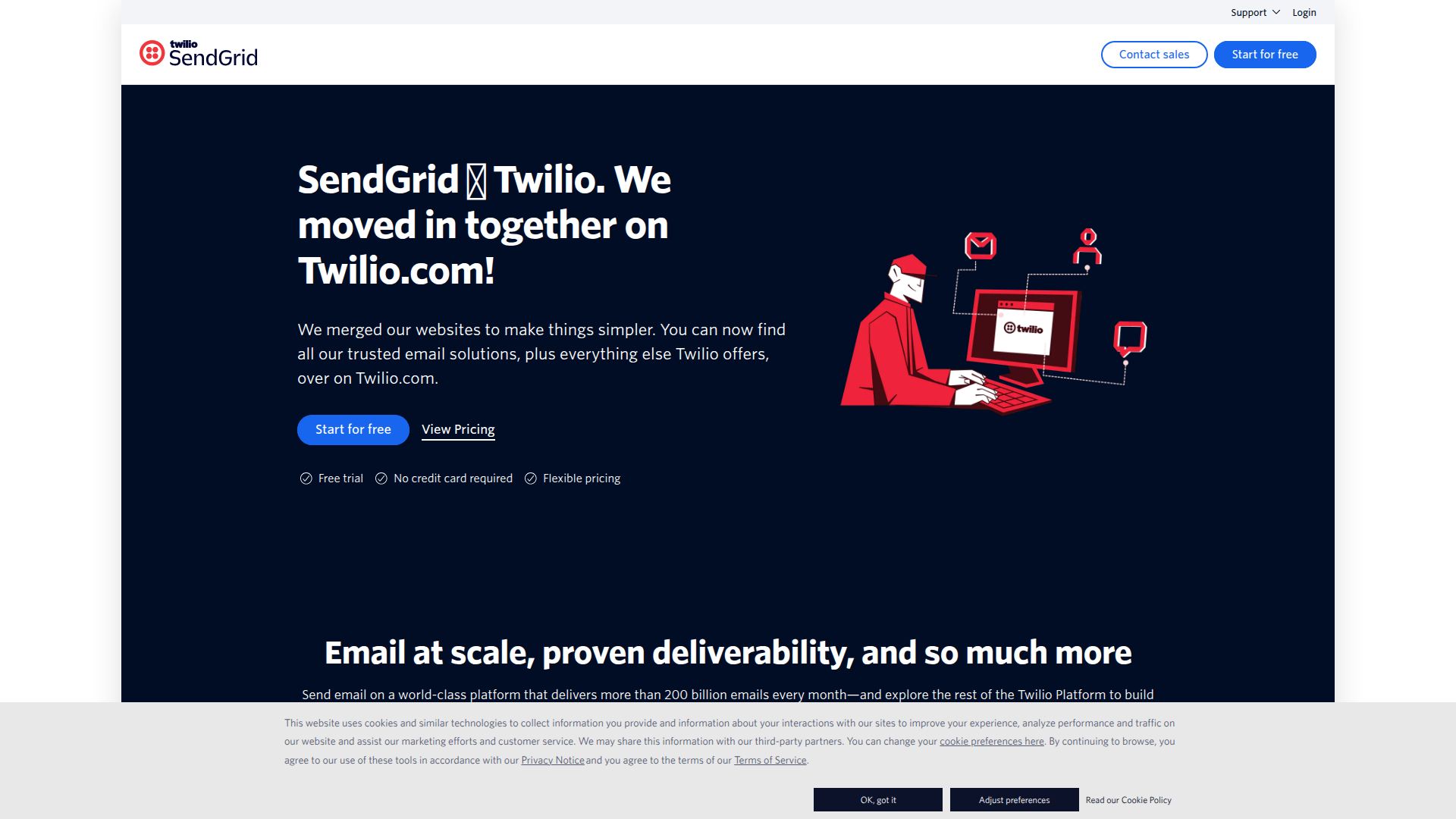
SendGrid's pricing page, as of October 24, 2026.
SendGrid is now part of Twilio, and its website has moved onto Twilio.com with the same email products, documentation and resources. It offers the Email API and SMTP service for application mail and Marketing Campaigns for marketers, with a free trial that needs no credit card.
Pick it if you already run SMS, voice or verification on Twilio and want email on the same account and bill. Ask before you commit how marketing traffic is separated from transactional traffic on shared IPs, and how long message history is kept on the plan you are buying.
Mailgun
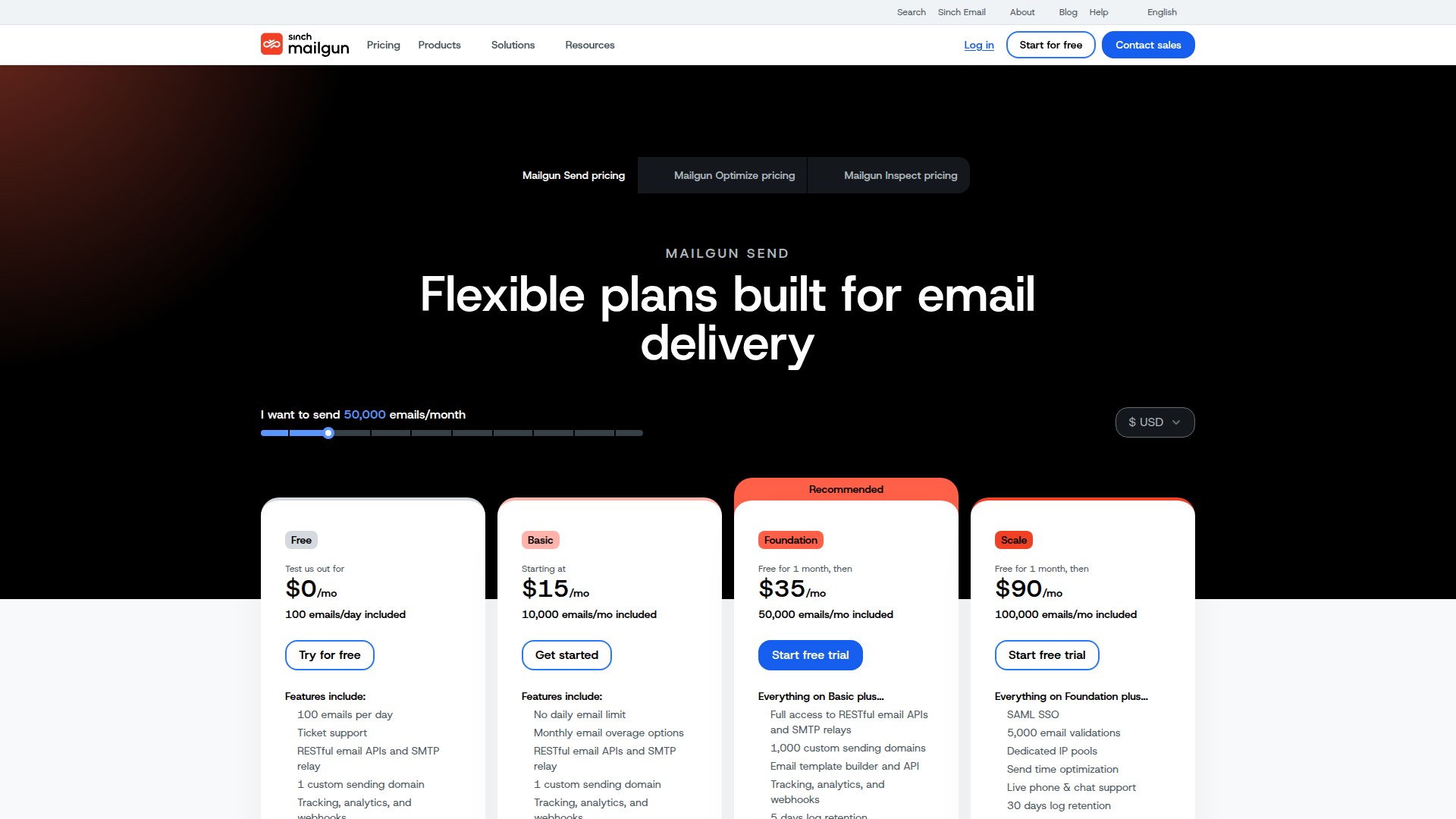
Mailgun's pricing page, as of October 24, 2026.
Mailgun gives the clearest plan ladder of the two: Free at 100 emails a day, Basic from $15/mo for 10,000 emails, Foundation at $35/mo for 50,000, and Scale at $90/mo for 100,000, with the first month of Foundation and Scale free. You can send through the US or the EU from a single account, which helps with data residency questions. Email validation is sold alongside sending, with 5,000 validations included on Scale.
The plan ladder also gates things teams often assume are standard. Multi-user access, role permissions, RBAC API keys and the uptime SLA start at Foundation. SAML SSO, dedicated IP pools, send time optimization, and chat and phone support start at Scale.
Pick it if you want a well-documented API, EU sending, and a clear price at 50,000 or 100,000 emails a month. Ask before you commit how mailing list traffic is kept apart from your transactional mail on shared IPs.
Other providers on the same shortlist
Postmark sells four plans, each starting at 10,000 emails, with 45 days of message retention by default and dedicated IPs from $50/month per IP once you send 300,000 a month. Its pricing page also lists message streams for marketing, bulk and broadcast mail. Postmark's pricing.
Resend offers a free-forever plan capped at 100 emails a day and bills monthly only. Its homepage pitches both transactional and marketing email, and its pricing FAQ separates the two by API: /emails for transactional, /broadcasts for marketing. Resend's pricing.
Amazon SES sits inside AWS, which describes its services as pay-as-you-go on its pricing overview: you pay for what you use, with no long-term contracts.
Mailjet sits under Sinch alongside Mailgun and is built for marketers as much as developers, with segmentation, landing pages and automations on its higher plans. Its free plan is the most generous on volume here at 6,000 emails a month. Mailjet's pricing.
Brevo is a marketing, CRM and messaging platform whose pricing FAQ says every plan includes transactional email features, with APIs, SMTP and webhooks. Brevo's pricing.
Where Groundmail fits as the third option
Groundmail sends transactional email (password resets, sign-in codes, receipts, alerts) from mail servers and IP space we own and operate. Our shared transactional IPs carry only that kind of mail: product email and opt-in newsletters send from their own IPs, and cold email and purchased or scraped lists aren't allowed at all. When you need isolation for volume, a security review or procurement, dedicated IPs and a dedicated server sit behind the same API you started on. Our deliverability page explains how we protect the pool.
When Groundmail is the wrong choice
Groundmail sends opt-in newsletters only for accounts we approve, marketing campaigns are coming later, and cold outreach is never allowed. Teams that need campaigns today are better served by a marketing platform such as Mailjet or Brevo, or by SendGrid's Marketing Campaigns. Keep your campaigns there and your resets and receipts on a transactional sender. A sign-in code should never wait behind a promotion.
Which one to pick
- Already on Twilio for SMS or verification: SendGrid, for one account and one bill.
- Need EU sending and a clear price at 50,000 or 100,000 emails: Mailgun.
- Want app mail and newsletters in one platform: Mailjet or Brevo, and accept that both kinds of traffic share a vendor.
- Want your transactional mail on IPs of its own and to know who runs the servers it leaves from: Groundmail.
Send your first email with Groundmail
Groundmail sends with one request to POST /emails, or through SMTP if your framework already speaks it. The Free plan covers 3,000 emails a month on up to 3 domains, which is enough to wire up resets and sign-in codes and watch them land. Create your free account and send a test message to your own inbox.
Frequently asked questions
Is SendGrid or Mailgun cheaper?
Mailgun's plans are Free, Basic from $15/mo, Foundation at $35/mo and Scale at $90/mo. Compare those with SendGrid's current plans on Twilio's site at your actual monthly volume, and include overage rates, since those decide the bill once you pass the included emails.
Does Mailgun have a free plan?
Yes. Mailgun's Free plan sends 100 emails a day with one custom domain, 1 day of log retention and one inbound route.
Does SendGrid have a free option?
SendGrid's homepage offers a free trial with no credit card required.
Are Mailgun and Mailjet the same company?
Mailgun's site lists Mailjet and Email on Acid alongside it under Sinch.
Do I need a dedicated IP for transactional email?
Usually not at first. Mailgun gives access to one at 50,000 emails a month and includes one on Scale; Postmark requires 300,000 a month; Resend requires more than 3,000 a day on Scale. Below those volumes a clean shared pool is generally the better start.
How do I migrate from SendGrid to Mailgun?
Mailgun publishes a handbook that maps SendGrid terms to Mailgun's and covers both SMTP and API paths. Send a low-risk message type through the new provider first, then move the rest.
Can I send newsletters through Groundmail?
Yes, opt-in newsletters, once we approve your account (email support@groundmail.dev). They go out from their own IPs with one-click unsubscribe, separate from your transactional and product email, so a newsletter can't hurt your sign-in codes. Marketing campaigns are coming later. Cold email and purchased or scraped lists are never allowed.